

For the last 8 years, no matter if we needed a new set of exhaust filters, or our intake wasn't quite giving us the numbers we needed, Vince has been there to answer our questions. He showed up when we were naively following what we were told we "should" be buying from the bigger corporations, who were just marking up the same units, and not even calling us back when we had issues or questions. If you want professional service and someone who actually cares about your business and what you need, you've found it.
— Sean, Owner | FFLC
Your Range. Your Reputation. Your Air.
OSHA-compliant air filtration for indoor shooting ranges — HEPA, MERV 14, and pre-filter systems that protect your shooters, your staff, and your license.
Lead Dust Isn't Optional. Neither Is Filtration.
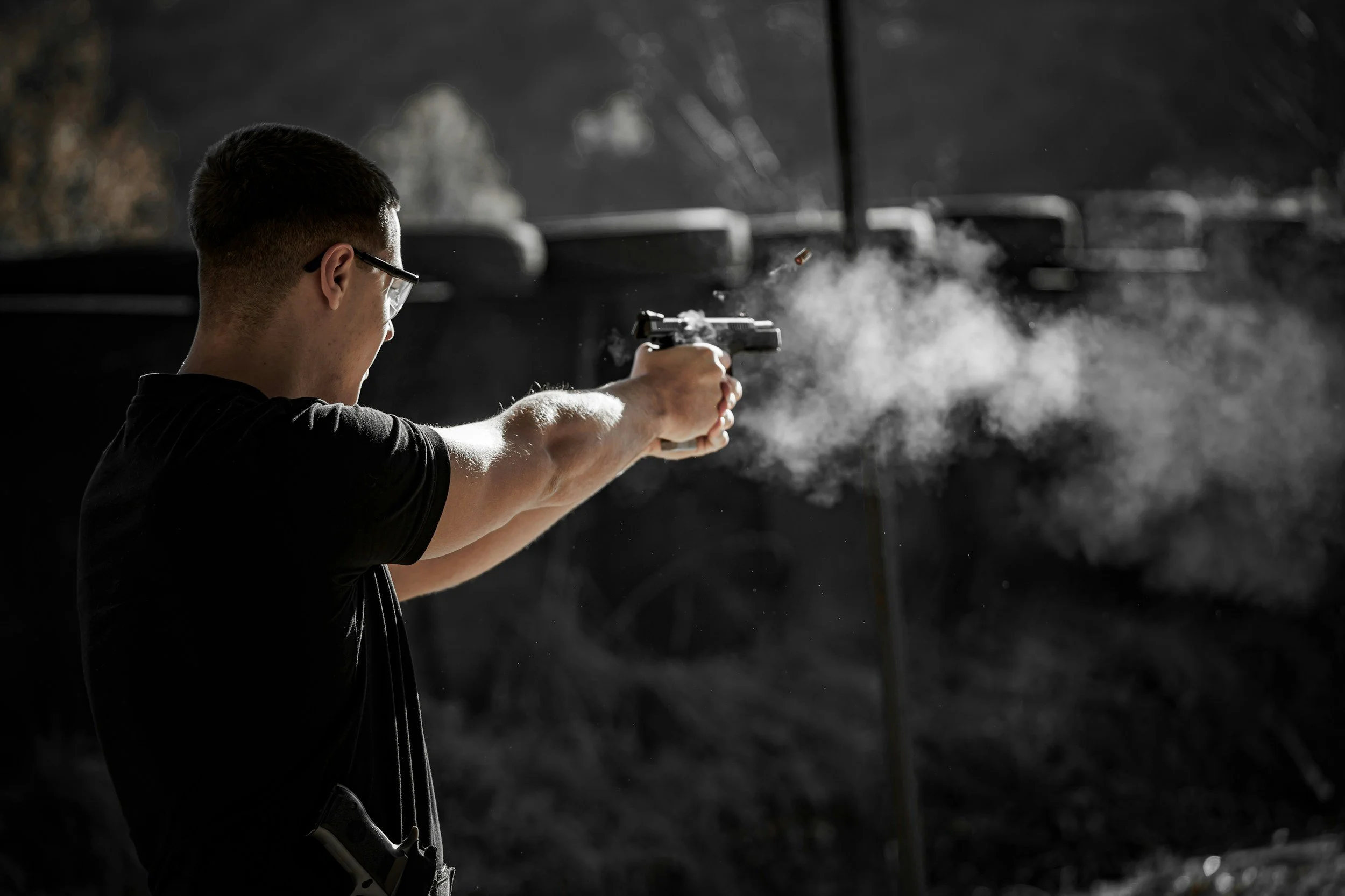
Every round fired inside your range releases lead particulate into the air. OSHA's permissible exposure limit for lead is 50 micrograms per cubic meter — for workers over an 8-hour shift. Violate it, and you're looking at citations, shutdowns, liability, and the very real cost of impairing the health of your customers and employees.
Federal regulations require HEPA filtration on all indoor range ventilation systems — both closed-loop recirculating and direct exhaust designs. That's not a suggestion from your HVAC contractor. It's the law.
The good news: the right filter stack keeps you compliant, protects your people, and doesn't have to break your maintenance budget.
OSHA Lead Standard
29 CFR 1910.1025 sets mandatory air quality limits for lead exposure in occupied spaces
HEPA Required
Minimum 99.97% efficiency at 0.3 microns on all exhaust or recirculated air
MERV 14 for Make-Up Air
ASHRAE 52.2 requires MERV 14 minimum on all incoming supply air
Three Stages. Every Stage Matters.
Indoor range filtration typically involves three stages, each with its own compliance and performance requirements. Every application is different — lane count, volume of fire, ventilation design, local air quality, and contaminant loading all affect what the right solution looks like for your facility.
Stage 1 — Make-Up Air Filtration
Incoming supply air requires filtration before entering the range. Commonly used filters in this application include bag filters and high-capacity V-cell filters rated to meet or exceed ASHRAE 52.2 requirements.
Stage 2 — Pre-Filtration (Range Side)
A pre-filter stage protects your final filter and extends its service life considerably. Commonly used filters in this application include panel filters and V-cell filters selected based on contaminant loading and system airflow.
Stage 3 — Final HEPA Filtration
All exhaust or recirculated air must pass through a HEPA filter rated at minimum 99.97% efficiency at 0.3 microns before re-entry or discharge. This stage is federally required — not optional, not substitutable. Commonly used filters in this application are true HEPA units sized and configured to the specific ventilation system.
Every range is different. Contact us to discuss what your application actually requires before purchasing. If HEPA, MERV, and other filtration are coming from separate vendors, our vendor consolidation guide covers what it takes to bring those under one partner.
Ranges That Trust Vince
For years, Vince has supplied indoor ranges across Colorado and Texas with compliant, value-engineered filter systems — not just once, but for years. These aren't one-time transactions. They're ongoing supply relationships built on accountability, on-site assessments, and filters that actually do their job.
Franktown Firearms — Franktown, CO
One of Colorado's premier indoor shooting ranges. We've been on-site, understand their system, and have worked with them directly on their filtration needs. Range operators in Colorado face the same OSHA lead standards as anywhere else — and finding a supplier who can navigate that and deliver without the runaround is harder than it should be.
Texas Gun Club — Houston, TX (Stafford & League City)
Texas Gun Club operates two high-traffic commercial locations serving thousands of shooters. We came in, walked both facilities, reviewed their full filtration setup, and built a compliant filter program that met OSHA lead dust requirements without overspending. Supplied for multiple years — the kind of relationship that only ends when you exit the business.
Saddle River Range — Conroe, TX
Saddle River is an indoor range and training facility that needed more than just product — they needed a better approach. We assessed their existing system, identified where filters were failing early, and provided alternative filtration options that extended service life and reduced their per-year spend. That's the value of a supplier who actually understands the full application — which includes contaminants, loading, and regulatory requirements.
Spring Guns & Ammo — Multiple Locations
Multi-location operations have a higher bar: every facility has to be compliant, and filter programs have to scale. We supplied Spring Guns & Ammo across their locations for multiple years with a consistent, compliant filter stack.
We Know Filtration. We Know Compliance.
Vast Filtration isn't a general industrial supplier that happens to carry a few range filters. We come from a filtration background — three generations deep — and we've spent years inside range facilities, talking to owners, walking ventilation systems, and building filter programs that hold up under real conditions.
✅ We know the application. We'll assess your system, understand your contaminant loading, and recommend what the code actually requires for your specific setup.
✅ We have what you need. HEPA, MERV 14 bags, MERV 15 V-cells, MERV 13 panels, bulk media — available and ready to ship.
✅ We move fast. Range downtime costs money and customer trust. We don't string you along with lead times that kill your schedule.
✅ We don't oversell. The right filter for your application is the one that matches your system — not the most expensive option on the shelf.
Firing Range Filters (typical)
HEPA Filter — Exhaust final filter/ recirculation final filter (99.97% @ 0.3µm)
MERV 14 Bag Filter — Make-up air supply filtration, initial exhaust filter (MERV 14)
MERV 15 Vee Cell — Secondary filter for exhaust, high volume (MERV 15)
MERV 13 Panel Filters — Pre-filter stage, standard use ranges (MERV 13)
Bulk Media Pads — Custom pre-filter / bullet trap intake (Varies)
Miscellaneous other filters for your specific application
Frequently Asked Questions
What filtration does OSHA require for indoor shooting ranges?
OSHA's lead standard (29 CFR 1910.1025) requires indoor ranges to maintain air lead levels below 50 micrograms per cubic meter. The most effective and commonly required method is HEPA filtration on all exhaust or recirculated air, rated at minimum 99.97% efficiency at 0.3 microns. Make-up air supply should be filtered to MERV 14 minimum per ASHRAE 52.2.
How often do I need to change HEPA filters in a shooting range?
Change intervals vary based on lane count, volume of fire, contaminant loading, and whether pre-filters are in place. A properly staged pre-filter system can extend HEPA service life significantly — commonly in the range of 12 to 14 months with effective pre-filtration. Monitor differential pressure and replace when drop exceeds manufacturer spec.
What's the difference between a closed-loop and direct exhaust range ventilation system?
A closed-loop system recirculates filtered air back into the range — the HEPA filter runs continuously and must maintain air quality at all times. A direct exhaust system pulls air downrange and exhausts it outside, also requiring HEPA filtration before discharge. Both are legal; both require HEPA. Closed-loop systems are more energy efficient; direct exhaust systems are simpler to maintain.
Do I need a HEPA filter for make-up air or just for exhaust?
Make-up air (incoming outdoor air) requires MERV 14 filtration minimum — not HEPA. HEPA is required on the exhaust or recirculated air side, where lead-laden air exits the range. This distinction drives your two-stage or three-stage filter design.
Can I use a MERV 13 filter instead of HEPA in a shooting range?
Not for exhaust or recirculated air. MERV 13 captures the majority of particulate but does not meet the 99.97% @ 0.3 micron standard required for HEPA compliance. MERV 13 is appropriate as a pre-filter stage — protecting your HEPA and extending its life — but cannot substitute for it in the final filtration position.