

Overspray, Dust, and Rinse Water — All Filtration Challenges
Filtration for paint and powder coating operations — spray booth air filtration, dust collection, and process and rinse water filtration, all in one place.
Overspray Doesn't Stay in the Booth on Its Own.
Paint and powder coating operations generate airborne hazards that move fast if the booth isn't pulling its weight. Paint overspray can carry metals, polyisocyanates, and organic solvents — materials linked to respiratory irritation, skin and eye sensitization, and reduced lung function with repeated exposure. OSHA doesn't set a single permissible exposure limit for isocyanates, which makes proper ventilation and filtration the primary control, not a backup to respirators.
OSHA's spray booth standard, 29 CFR 1910.107, requires that particulate-laden air be vented away from the operator and discharged to the building exterior — exhaust air containing flammable vapors generally can't be recirculated back into the building. Airflow has to be maintained at a minimum velocity, typically 60 to 100 feet per minute depending on application method, and that velocity depends directly on filters that aren't clogged or overloaded.
This isn't a once-and-done system. Filters that load up with overspray drop airflow below code minimums quietly, long before anyone notices a problem — which is exactly why filtration in this application gets checked on a schedule, not on a hunch.
Booth Filters Are Doing More Work Than Most Realize.
Booth filtration typically works in stages. Intake filters condition incoming makeup air before it ever reaches the spray zone, keeping dust and debris from landing in wet paint. Exhaust filters — arrestors, in industry terms — capture overspray particulate before air leaves the booth, protecting both compliance and your exhaust fan from buildup.
Finishing-style paint arrestors are built to remove the vast majority of overspray particulate without dragging airflow below the velocity OSHA requires — but that performance only holds if the filters are changed on schedule. Pressure drop across the filter bank is the signal that matters: once it climbs, airflow drops, and the booth stops doing its job even though it's technically still running.
Commonly used filtration in this application includes prefilter blankets, intake filters sized to booth volume, and exhaust/arrestor filters matched to your coating type, application method, and how much volume you're spraying.
Powder Coating Trades Overspray for Fine Dust — A Different Filtration Problem.
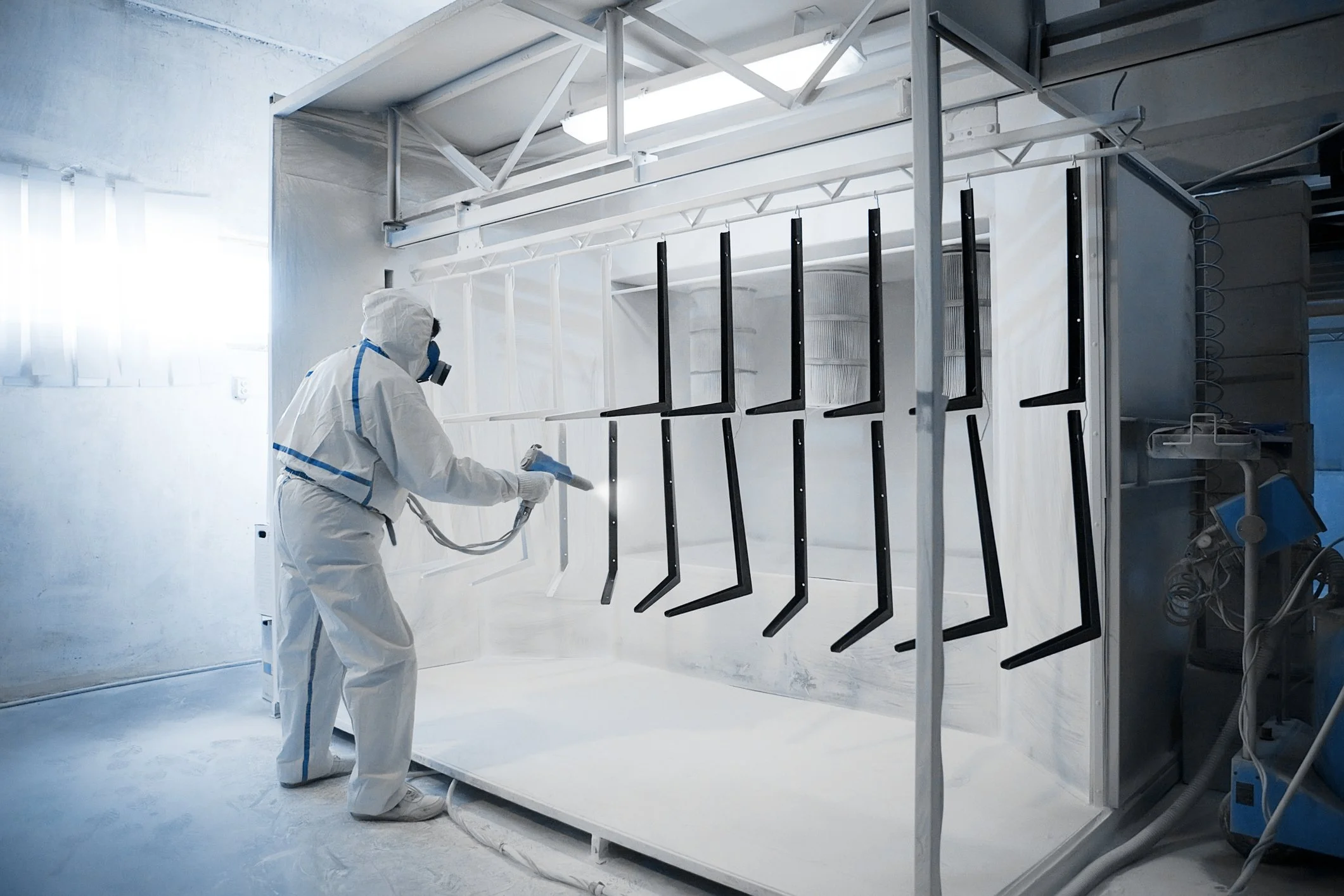
Powder coating doesn't generate wet overspray, but it creates its own filtration challenge: fine, electrostatically charged powder particulate that has to be captured before it builds up in ductwork, settles on equipment, or becomes a combustible dust hazard. Recovery systems also matter here in a way wet paint booths don't — well-filtered dust collection lets you reclaim oversprayed powder for reuse instead of treating it as waste.
Cartridge filters are the standard for powder coating booths, chosen for their high surface area and ability to handle fine, lightweight particulate without blinding quickly. Because powder dust is combustible, filtration and dust collection in this application has to be sized and maintained with that risk in mind — not treated like a standard dust collection problem.
Commonly used filtration in this application includes cartridge filter dust collectors sized to booth airflow and powder type, with reclaim systems where overspray recovery is part of the operation. Valve and diaphragm maintenance is key in these systems.
Pretreatment and Rinse Water Carry Their Own Filtration Load.
Before paint or powder ever touches a part, most finishing lines run it through a pretreatment process — wash stages, phosphate or conversion coating baths, and rinse stations designed to clean and prep the surface for better adhesion. Every one of those stages depends on water that's actually doing its job, not water loaded with contamination from the last hundred parts that went through it.
Rinse water picks up oils, phosphates, and metal fines as parts move through the line, and if that water isn't filtered, contamination carries forward onto the next part — undermining the same adhesion and finish quality the pretreatment stage exists to protect. Bath life also shortens when contaminant load isn't managed, which means more frequent dumps, more fresh water and chemical use, and more disposal cost.
Commonly used filtration in this application includes bag and cartridge filtration for rinse stages, with finer filtration or media systems for pretreatment baths carrying heavier oil or solids loads.
We Match Filtration to the Line, Not a Generic Spec Sheet.
Vast Filtration comes from a filtration background three generations deep, covering both air and liquid filtration. For paint and powder coating operations, that means looking at your actual booth, your actual line, and your actual water — and matching filtration to that, instead of a one-size-fits-all answer. When booth air, dust collection, and process water are handled by separate vendors, our vendor consolidation guide covers what it takes to bring those under one partner.
✅ We understand the application. Spray booth air, powder dust collection, and pretreatment water are three different problems, and we don't treat them the same.
✅ We have what you need. Booth intake and arrestor filtration, cartridge dust collection, and process/rinse water filtration — matched to your actual line.
✅ We move fast. Down booths and stalled lines don't wait. We don't string you along with lead times that put your schedule at risk.
✅ We don't oversell. If a simpler filtration approach solves your problem, we'll tell you — not push more than you need.
Frequently Asked Questions
Does OSHA require minimum airflow in a spray booth?
Yes. OSHA's spray booth standard, 29 CFR 1910.107, requires that particulate-laden air be vented away from the operator, with airflow maintained at a minimum velocity — typically 60 to 100 feet per minute depending on application method. Filters that load up with overspray reduce airflow below these minimums, often before that drop is obvious without monitoring pressure.
Can spray booth exhaust air be recirculated back into the building?
Generally, no. Exhaust air containing flammable vapors must be discharged to the building exterior and can't be recirculated unless the system is specifically designed and approved for recirculation with appropriate filtration and monitoring in place.
Why do powder coating operations need different filtration than wet paint overspray?
Powder coating produces fine, electrostatically charged, and often combustible dust rather than wet overspray. Cartridge filters are the standard choice because they handle that fine particulate without blinding quickly, and dust collection systems in this application need to account for the combustible dust risk that wet paint booths don't have.
Does rinse water contamination actually affect finish quality?
Yes. Rinse water picks up oils, phosphates, and metal fines as parts move through the pretreatment line. If that contamination isn't filtered out, it carries forward onto subsequent parts, undermining adhesion and finish quality — and it also shortens bath life, driving more frequent dumps and higher water and chemical costs.